

Greetings, Earthlings!
Here is a not-so-brief summary of my reading and writing ventures from my second week on the blog. I wrote little, and read lots. I read (or rather listened to via audiobooks) seven books, from last weekend (Saturday evening, 1/3) to this morning (Saturday 1/10). I’m trying to reintroduce regular morning and evening reading with physical books and I think it’ll be a little easier once I’m back in my weekly routine. I work in a school district, and school returns this Monday, so my schedule has been out-of-whack these last few weeks. And when I say “reintroduce”, I mean I read my first physical book of over five years last May. I have only read four more since then. The rest (over 260) of which have all been audiobooks. I’m in the middle of a few physical books at the moment, Moby-Dick, The Martian Chronicles, Star Wars: Lando Calrissian and the Flamewind of Oseon, Robert Frost’s Poems, and The Quest for Character, to name a few.
Of Writing
This week I spent most of my time reading, or out, or working on a personal project of mine cataloging my personal and audio libraries. This project has taken up a lot of my time, and I’ve been listening to several audiobooks while working on it. I neglected my manuscript-in-progress, MORTIMER, and have been focused on this instead. I did, however, write a 1,200-word Personal Statement that I submitted for an MLIS application, and this blog, so that’s something. This coming week, once I’ve finished up this project, because I won’t be able to fully focus until then, I’ll return to writing my first draft of my new spooky, Gothic story.
Of Reading
This week I read seven novels! I don’t typically read that many in a week, though to be fair, some of them were continuations from last year, and others were rather short, and school has been out for the kids (the middle schoolers, not mine, I don’t have any). Below is a brief review and summary of each. As the week’s go on, I feel my reviews will get longer as this the first time I’m doing something like this that isn’t a book report or an argumentative essay. Three out of four of these are science fiction, three are fantasy (Star Wars is not technically science fiction, more like Fantasy/Space Opera), and the other is contemporary fiction. Feel free to read which ones interest you, and skip the ones you don’t care much for. I hope you enjoy!
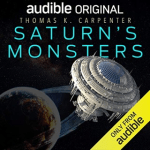 #1 Saturn’s Monsters by Thomas K. Carpenter
An interesting little sci-fi novella that takes place on a space station called Saturn Two. The story follows a small team of scientists aboard the space station, whose mission is to create interstellar starships, called Monsters, from nanobots and diamond-like materials from Saturn’s stormy atmosphere using AI technology. A subplot of the story involves the main character in a romantic relationship with another crew-mate, and the MC’s desire to bring back her deceased wife and daughter from fifteen years ago using technology she developed that supersedes death by utilizing AI and memory recovery.
The sci-fi elements I just described are interesting as they utilize current technology and combine it with “what-ifs” of what could be future tech, against a background that serves only the plot. The story involves a lot more romance than it does science fiction; there’s more dialogue amongst the crew of characters than there is exploration, building, designing, and describing the tech itself. Carpenter does explain the tech to an extent, but it falls a bit short of engaging with hard science fiction. Another thing that is left unsaid is the amount of people actually working on the project. You’re left to assume that there’s only a handful of scientists on the space station, when it feels like there should be hundreds on a project of this scale in the atmosphere of our beloved gas giant. These two facts are what earned it 3/5 stars from me. I did enjoy the science fiction, though I feel it had potential that wasn’t explored, likely because it was written as a novella.
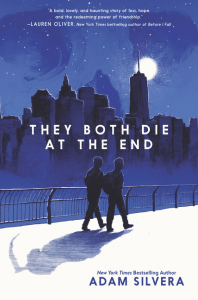 #2 They Both Die at the End by Adam Silvera
By golly, I loved this little book. I started it last year, months ago. And as always, I put it down – again, and again. Not because I disliked it, but because I’d always begin something new. Truthfully, it did feel like a bit of a slow start for me, and I’m not always a huge fan of modern fiction – contemporary, yes – but modern is always a hit or miss for me. It has to really suck me in for me to continue right away. I’d say that’s probably the case for most books anyway, which is why I’m reading so many at once.
In short and sweet words, the premise features two main characters who are set to die at the end of the novel, spoilers if you ignored the title. In this modern society, a website/company called ‘Death Cast’ calls you if you’re going to die that day. They don’t tell you how, or when exactly, but that it’ll happen that day. There’s also a ‘Last Friend’ app where people who have been called can hit up other people who’ve also been called. Some people, like our MCs, just do so to find a final friend, others probably for more than that.
So, that’s how they meet, a dating app for just friends who are going to die because a website told them they would. These two characters couldn’t be more unlike each other. One, a nerdy kid whose mom is dead and whose dad is in a coma. The other, a foster kid who kind of hangs around the wrong type of crowd. Both about 17 or 18, and in high school. The whole story takes place over an entire day, from about 1am to about 10pm, and the two develop a friendship, that – spoilers – turns into a bit more, I don’t know, the cover kind of gives that away, too. But the ending, oof, the ending is just brutal. Getting to know a character, and how much they mean to the other MC and other characters in the story, and then to just be ripped away, is quite heartbreaking. I listened to the audiobook version of this, and the last hour and a half or so just had me hooked on so tightly, I couldn’t let go, unlike Mateo letting go of Rufus when he heard the fire alarm go off, if you know, you know. Boy, did I shed a tear to that. Although it was a slow start, I ended up giving this book five stars for how the plot played out and how the ending just tore me apart.
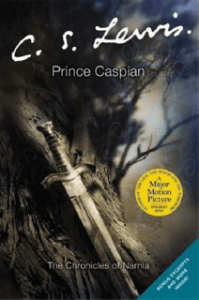 #3 Prince Caspian by C.S. Lewis
This was a sweet little book. Last year, I read The Magician’s Nephew and The Lion, the Witch, and the Wardrobe, chronologically, the first two in the Chronicles of Narnia series by C.S. Lewis, for the first time. I loved The Magician’s Nephew, and of course the latter is a classic, commonly known by millennials from the 2005 film, which beautifully captures the story.
The four siblings, Peter, Susan, Edmond, and Lucy, return to Narnia to aide young Prince Caspian X recapture the throne of Narnia from his wicked uncle King Miraz who doesn’t believe the “fairy tales” of the land in which he himself lives. How silly, I must say. Caspian learns the truth from his tutor, who’s a squat, little dwarf in disguise and flees the kingdom, and across the pond, where he runs into none other than the Pevensie siblings, once Kings and Queens of Narnia, hundreds of years prior. Because a year in Telmar – ahem, Earth – is about 1,300 years in Narnia. 1,300! Talk about how time flies. Sheesh, Aslan is old as dirt now.
Anyway, Lewis seems to always do a lovely job at capturing the emotions of the characters and the settings of the story in his writing. And the story as a whole was short and sweet and hit all the normal plot beats, and is perfect for little adventure-faring Pevensie children all over the world. This book earned a solid 4/5 stars from me.
 #4 Star Wars: Reign of the Empire: The Mask of Fear by Alexander Freed
This book was a doozy. I’ve finally gotten around to finishing it, too. For a while, this was my book to listen to while running, and I’d gotten about half way through it when I realized I needed to start it over because I couldn’t remember what was being talked about. So, a few months later, I restarted the book, only to run into the same kind of scenario. As much as I love utilizing running as an excuse to listen to more audiobooks, I don’t think I’m very good at retaining the information while running, as I’m too focused on the road ahead. So, the other day, I clicked play again, and instead of starting it over a third time, I picked it up where I’d left off… which was about half-way through.
If you enjoy political thrillers with very little action, then this book is probably for you. Watch how Senators Mon Mothma and Bail Organa navigate the new political climate as Palpatine’s reign begins. Palps himself isn’t even in the novel, and only mentioned by name. We are seeing the Empire on a (upper-class) citizen level, with people who work for the Senate. Mon is still pushing policy as normal, but with emphasis on getting Palps out of office. Bail goes off-world to investigate the genocide of the Jedi, with Haki, an Imperial spy on his tail. They end up entangled in the moral ambiguities of the Empire and Haki begins to understand the horrors that it’s inflicting on the rest of society.
Saw Gerrera, an extremist and so-called terrorist, recruits Soujen at the beginning of the novel, who’s an ex-Separatist assassin and has been mostly modified to be “more machine than man”. Saw is as Saw does. He’s the same version we get in Clone Wars and Rogue One. Soujen is a new face we get, an extremist in the making, and wanting to undo Palpatine’s regime as the Empire essentially eliminated the Separatists and their cause.
Without getting into specifics, Freed clearly draws the political climate of the early days of the Empire in the novel from our own and mirrors what we see in today’s society. We see terrorism and politicians becoming prisoners and tortured. We see real-life events bleeding from the lives of these characters, and some of them hit far too close to home.
I gave this book 4 of 5 stars. It’s a stellar political thriller with your daily dose of Star Wars sprinkled through it.
 #5 Star Wars: X-Wing: Wraith Squadron by Aaron Allston
Another book I finally got around to finishing. This one I also had to restart once or twice, I’d be listening to but it would become almost like a background noise, and then I’d realize I would have no idea what was happening. So I restarted it several months ago, and now I can move on to book six of the series. Wraith Squadron is Book five of the X-Wing series (published in ’98), and book one of the Wraith Squadron series. Wraith Squadron is an X-Wing unit formed by Captain Wedge Antilles following the Bacta War (also the name of book four) and the Battle of Thyferra.
The squadron is made up of misfits and wash-outs in an attempt to prove that not every esteemed fighter pilot is shiny and smooth with clean records. Admiral Ackbar only approved of the squadron’s formation if Antilles served under Ackbar’s staff (as a promotion) if the project were to fail. The dynamic between the newly-formed team led to arguments and even a fist-fight or two, but as the team worked together on missions, they developed a camaraderie so strong that when certain members perish in battle, others feel immense regret for not being able to save them or pure hatred toward the opposition. There’s even an admitted attraction and light romance between two of the characters in the second half of the book.
A major turn of events occurs when Wraith Squadron infiltrates and captures Night Caller, a post-imperial Corellian Corvette previously captained by Zurel Darillian. Darillian had actually been vaped by Piggy’s X-wing laser cannons, and the team later discovered that the captain had been recording his diary entirely in holograms. This gave the team an edge as Garik “Face” Loran, a Wraith who was previously an actor, used the holos as an overlay so that he could impersonate the late Darillian in an attempt to help Wraith Squadron subvert Warlord Zsinj’s war efforts, which is ongoing for a majority of the remaining chapters.
I enjoyed the impersonation plot device that allowed the Wraiths to fly around in a Darillian’s Corvette and get under Zsinj’s skin, almost like teasing your siblings by knocking them off their bike and stealing it to ride around the neighborhood. Even though some of the members of Wraith Squadron died in the final battle (spoilers – it’s Star Wars, someone is going to die at some point – I just won’t say who), it’s still a gut-punch when it happens, after coming to admire the friendship they started to build. I’m excited to see who joins the team in X-Wing: Iron Fist (since, you know, some died), what their new plans will be, and what becomes of Tainer and Sarkin, if you know, you know.
I gave this book a solid 4/5 stars. It was good story, and very well-written, but it wasn’t necessarily gripping enough to hold me close.
 #6 The Time Machine by H.G. Wells
I’m surprised it’s taken me this long to get around to reading this little science fiction classic. It is quite short and I flew through it in an afternoon. The story is about an unnamed Victorian scientist who – spoilers – invents a Time Machine! A clever little book that begins with a sort of philosophical fireside chat with the scientist/inventor and a few others about the potential reality of more than just our usual three dimensions, that there is a fourth dimension – time. The others are in disbelief about it being true that one can move within this fourth dimension based on their philosophical answers within the context of the conversation. The narrator is a spectator, also unnamed, and we see the story from his POV, though most of it is really told by the scientist recounting his long journey through time at a dinner party.
The scientist travels to the year 802,721 C.E. Imagine going 800,000 years into the future. Just think about that for a moment. Humans evolved over millions of years to reach the current Homo Sapiens that we are now, about 200,000-300,000 years ago. And our scientist here travels almost triple that time into the future. The human race has evolved into essentially two versions: the Eloi and the Morlocks. The Eloi represent the rich, well-off, and the pleasure-seeking, whereas the Morlocks live underground and are forced to do hard labor. Oh, they also feed on the Eloi, their primary food source.
The story is rounded off nicely with the scientist fighting his way through the Morlocks and finally finding his Time Machine, which stays in the same spot or location no matter where it is in time, unless otherwise moved. I enjoyed that Wells had the scientist travel even further into the future, stopping at many points over and over again, and witnessing the burning out of the sun over millions of years. There’s even a point where he’s attacked by giant crabs that evolved over time. Can you imagine walking on a beach and an angry crustacean the size of your bedroom crawls out of the water? Gross. Anyway, I gave this book five stars due to its simple storytelling yet Wells’ writing sucked me in, and I wanted it to just keep going, and it’s an acclaimed classic, so I felt obligated.
 #7 Starship Troopers by Robert A. Heinlein
I hadn’t read any reviews of this book prior to reading it, nor did I know any basis for the storyline, I was essentially going in blind. I knew that this was one of his more popular stories and decided to give it a try. I was reeled in during the first chapter as Juan “Johnny” Rico is immediately thrust into an interstellar battle against the “Bugs”, the Arachnids on the planet of Klendathu. The first chapter is action-packed. The final chapter is also action-packed, sort of. The entire book otherwise is Rico either explaining training protocols for the M.I., or Mobile Infantry, or immersed into philosophical discussions with superior officers and teachers about society and government. There are a few chapters that are mere flashbacks. Some tell of Rico’s past, others of his father, who joins the service later on. There’s also a chapter where he just talks about the mech suit (or amoured suit) they wear in the M.I.
To be entirely transparent, I didn’t give this book the attention that it deserved. If you know me intimately, you’ll know that my reading and comprehension skills rely entirely on active reading or listening. If I have the book playing on audio while doing tasks that require my attention, I will miss a lot of information or have no idea what is going on. Unfortunately, that was the treatment I gave this book, and as a consequence, I came out of it only understanding surface-level context and not really any deeper meanings it’s supposed to have about conveyed fascist governments or other topics.
This book is going to go onto my list of necessary books to reread so that I revisit it later on with active ears, or give a close reading to the physical copy. For the time being, I gave this book 3/5 stars as I was only partially engaged with the story. and did enjoy the sci-fi elements it offered.
 T.P. Lanzarotto
Leave a comment