

Welcome Lanzothians!
Week five topped off January with my 15th read of 2026. I had to up my goal from 85 books this year to 120, since that’s what it seems I’m on track to accomplish. I haven’t read this much in a very long time, actually, probably never. And I’m not stopping any time soon.
Of Writing
I promise, I’ll get to my story this week. I may be making meek excuses, but I can give you two reasons why I’ve been putting it off, aside from laziness, that is. My story, MORTIMER, is about the first-mate of a merchant ship sailing from London to Brazil. It will mimic 1800s style writing, and in particular, that of Gothic Fiction. I wanted to finish reading Moby-Dick before getting back to my story, as a form of research to seafaring storytelling. I know Melville’s classic isn’t Gothic, but the language that revolves around the sea and the ships, and the many different seafaring terminologies, is the what I really wanted to learn about so that my story feels as authentic as possible. I also spent most of this week reading Moby-Dick as I’ve been putting it off, and so read over 500 pages of it this week alone, not giving me much time to write.
I did, however, while reading this piece of classic text, come up with some new ideas for my story, and I did go in a tweak the Epilogue a bit. Yeah, I wrote the Epilogue after chapter three back in December so that I had an ending to work towards.
Of Reading
 #13 Harry Potter and the Prisoner of Azkaban by J.K. Rowling
I know what you’re thinking – “Really? Again?” Hear me out. I typically re-read the Harry Potter series every few years. It’s one of those obsessive re-reads that I’ve always had. This time around is probably my sixth or seventh re-read of Prisoner of Azkaban. I hadn’t re-read the series since early 2023, so I decided to jump back into it last summer. Then, after finishing the series once again, it was announced that Audible would be releasing a new full-cast production of the series, one per month from November 2025 to May 2026. Now, if you listen to audiobooks, you know how wonderful full-cast recordings of books are. Having different narrators for different characters really immerses you, rather than just one narrator for all the characters. Sometimes you get lucky and have a narrator that does stellar voices for a variety of characters, and other times you get a narrator who doesn’t even try to change their voice.
I have already re-read The Philosopher’s Stone and The Chamber of Secrets upon release, and I must say that I’m full enjoying these new productions. The voice actors are perfect for their roles, they sound so much like how the characters should sound. In addition to the full-cast, Audible has included sound effects for the environment around the characters, everything from ruffling of papers and the whooshing of broomsticks to the barks of Fang, Hagrid’s dog, to the whimpering of Peter Pettigrew. Although I’ve read this book many times, the addition of these things is allowing me to notice more details about the story. When the trio are in the Shrieking Shack with Sirius Black and Remus Lupin, and the two have just transformed Ron’s rat, Scabbers, back to his original form of Peter Pettigrew, are offering him to the Dementors, his whimpering is described, but it never really hit me until his voice actor was emulating that emotion, and it felt real and terrible to hear (in a good way).
The book itself already holds a 9/10 for me, and the full-cast production of it definitely elevates it to a solid 10/10. I’m already looking forward to the Goblet of Fire full-cast releasing later this month.
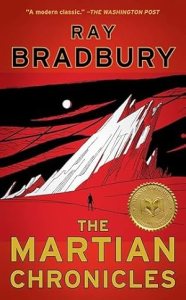 #14 The Martian Chronicles by Ray Bradbury
Man, Ray Bradbury does it again. I’ve only ever read one other book by him, and that book I’ve read at least three or four times, most recently in November, 2025. That was, of course, Fahrenheit 451 – one of my favorite books of all time, a true timeless literary classic. This one here, The Martian Chronicles, is so well written, I was on the edge of my seat the entire time. Bradbury has a way of writing fast-paced stories by the way he manipulates sentence structure, making it feel like you’re literally jumping from word to word on the page. Literally.
It was like reading a collection of short stories that were all intertwined, I suppose that’s why Chronicles is in the title. A red planet with Martians with the ability to make illusions, confusing old-timey space-men flying in on rocket ships from Earth. You can tell the writing is dated because the space-men smoke cigarettes on Mars, can breathe on Mars (with no issue), are not affected by gravity on Mars (also no issue there), and describe houses that the Martians built (to replicate the human’s back home) like mid-western 50’s architecture (because that’s what it is). I enjoyed every interaction, and every piece of mysterious wonder that made you curious with what was going to happen next.
The most interesting things, and I’m not sure if this is really a spoiler or not, is that nothing is ever explained. The illusions the Martians make. Their way of life. There’s a time-warp effect that is described a few times later on, also not explained. None of it. It feels as if he wrote it in a way to almost make you continually guessing at how things are the way they are. I really enjoyed how each chapter was its own little short story, though several characters, particularly some from the beginning of the story, reappeared in later chapters towards the end. The last 1/3 of the book just flew by, I just needed to know what happened next. Bradbury, my man, you did not disappoint. Though, as I said, nothing was ever really explained, at least not explicitly, and in terms of the plot and storyline, the ending tied things up pretty nicely, and I just remember my eyes widening as I read that very last page.
This book wholeheartedly deserves a 10/10. I may be too generous at times with ratings, or maybe I’ve just been picking up some goldmines, but this one was a true gem. Highly recommend for any Sci-Fi nerd out there.
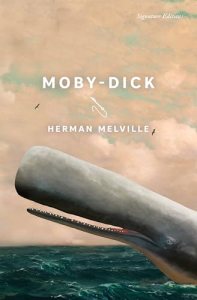 #15 Moby-Dick by Herman Melville
Wow. Just wow. Earlier this month I decided I’m going to embark windward on a journey to read at least 12 behemoth classic literature novels this year, one each month. By this I mean, 12 classic novels over 600+ pages each. To be frank, that number might have been higher if it had not been for this particular one falling a few pages short of 700. I think it actually might be the shortest I have on my list. I have some strong feeling about this book. It was arduous, for sure. If you don’t know much about the story, well, neither do I. I’m kidding. There’s just very little to tell about the actually storyline.
This book was part narrative, part philosophical, and part encyclopedic. I did really enjoy Ishmael’s point of view throughout the story, giving us his perspective of the events that happened upon the legendary Pequod, captained by the infamous Ahab. You know, the one with the wooden leg. Actually, it’s not wooden, it’s ivory, because he’s got a deep-cut grudge against the one leviathan, Moby-Dick. Ishmael, a harpooneer, set aboard the Pequod with the queer savage cannibal islander, Queequeg, about a hundred pages into the story. Yeah, you read that right. The two wandered around Nantucket for over a hundred pages before actually sailing away on the Pequod.
When I say the book was part philosophical, part encyclopedic, you’ll need to mentally prepare yourself to be learned of topics from whaling, to all manners of ships and whaling ships, harpooning, different types of whales, pictures of different types of whales, and everything in between. There’s even a chapter on a doubloon, otherwise a coin. (Many of these chapters aren’t very long, merely a few pages, as are the rest, but yet there are so many of them) Just six pages talking about this little coin that Ahab found. Actually, I quite enjoyed that one. But you need to be prepared to be taken out of the story for chapters on end while Ishmael discusses all manner of seafaring.
For the narrative (in addition to the two former), I really enjoyed how Melville describes the sea and the ship around the characters. He truly has a way with words. When ye old Moby-Dick appears on the page, his incredulity takes even the sailors by surprise, and excitement ensues. Part of the narrative, especially in the latter half of the book explores Ahab’s want for revenge with the great Moby-Dick, for his leg was bitten off some time ago by the leviathan, and he will literally stop at nothing to kill the whale. It takes us all the way to the final page of the book.
Though I would honestly describe Moby-Dick as a masterwork of a seafaring tale, it is very strangely written. Most stories give you a rising action, then climax, then a falling action, and a resolution. We all learned this in school. This is basic storytelling. There is no falling action, and if you were to tell me there was a resolution, I’d tell you it was on the last two pages, if you can consider it a decent resolution. The story seemingly ends with the climax. I don’t feel like we even hit the climax until after 400 or 500 pages in, and it lasts until the very last page – actually, the last page is Epilogue, so, the second to last page.
I’m sure you can tell I have several critiques about this novel and the way Melville structured it. I seriously did enjoy it, though at times the encyclopedic chapters dragged a bit, the narrative ones jumped us right back overboard. I’m glad I finally got around the reading this. And as much as I feel the need to give it 10/10 for being a well-respected classic, I’m going to have to give it an 8/10, for its jagged structure – with so many non-narrative chapters just wedged in between the storytelling – and its very abrupt ending (although the ending was a true spectacle).
If you’d like to read any of my reviews from this year so far, I have them all linked below:
Science Fiction: Saturn’s Monsters; The Time Machine; Starship Troopers; The Martian Chronicles
Dystopian: Anthem
Fantasy: Prince Caspian; Harry Potter and the Prisoner of Azkaban (full-cast production)
Star Wars: The Mask of Fear; X-Wing: Wraith Squadron; X-Wing: Iron Fist; Darth Maul: Shadow Hunter; X-Wing: Solo Command
Contemporary: They Both Die at the End
Literary Classic: The Metamorphosis; Moby-Dick
—
Thank you for reading along. My hope is to inspire more and more readers across various genres. Farewell, and see you again next weekend!
T.P. Lanzarotto
1 February 2026
 T.P. Lanzarotto
Leave a comment